
how to select inductor value for smps circuit?


The selection of the inductor value for a switch-mode power supply (SMPS) circuit depends on several factors, including the desired output voltage, output current, switching frequency, and ripple current. Here are some general guidelines to follow when selecting an inductor value for an SMPS circuit:

Determine the desired output voltage and output current: The inductor value will depend on the desired output voltage and current of the SMPS circuit. The output voltage and current will determine the minimum inductor value required to meet the load requirements.
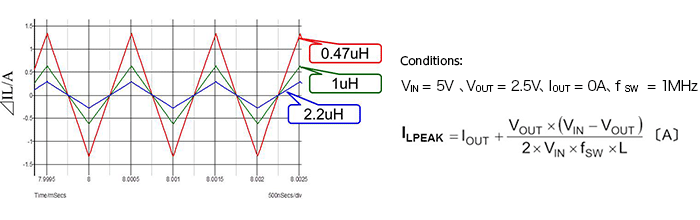


Consider the switching frequency: The switching frequency of the SMPS circuit will also affect the inductor value. Higher switching frequencies will require smaller inductors, while lower switching frequencies will require larger inductors.


Calculate the ripple current: The ripple current is the difference between the maximum and minimum current flowing through the inductor. To minimize the ripple current, a larger inductor value is generally required.


Consider the DC resistance of the inductor: The DC resistance of the inductor can affect the efficiency of the SMPS circuit. Lower DC resistance will improve the efficiency.


Consider the core saturation: The inductor should be selected to avoid core saturation during the switching cycle. Saturation will cause the inductor to lose its inductance.


Consider the physical size: The physical size of the inductor also has to be considered to fit the design constraints.

It is recommended to check the manufacturers recommended datasheet for the specific component and also simulate the circuit using simulation software.

Comments

Popular posts from this blog

SPI USING VHDL VERILOG ALONG WITH TEST BENCH

SPI (Serial Peripheral Interface) is a synchronous serial communication protocol that is commonly used for communication between integrated circuits. It has a simple, 4-wire interface: a clock (SCLK), a master output slave input (MOSI), a master input slave output (MISO), and a chip select (CS or SS). In a typical SPI communication, the master device generates the clock signal and controls the chip select signal to select the slave device it wants to communicate with. The master then sends data to the slave on the MOSI line, and the slave returns data to the master on the MISO line. The data is transmitted and received in parallel, with each bit being transmitted on a separate clock cycle. Here is an example of how you might implement an SPI interface in VHDL: Copy code library ieee;  use ieee.std_logic_1164.all;   entity  spi is    port (   sclk : in std_logic;   mosi : in std_logic;   miso : out std_logic;  cs : in ...

how to write MSB and LSB in verilog

  In Verilog, you can use the concatenation operator "{" and "}" to specify the most significant bit (MSB) and least significant bit (LSB) of a vector.   For example, suppose you have a 4-bit vector called "data" and you want to select the LSB (data[0]) and the second most significant bit (data[2]). You can do this using the following code:   Copy code

Types of communication interfaces ?

 Communication interfaces facilitate the exchange of data, signals, or information between different systems, devices, or components. Here are several types of communication interfaces commonly used in various domains: 1. Serial Communication Interface:    - Serial communication interfaces transmit data one bit at a time over a single communication channel. Examples include RS-232, RS-485, UART (Universal Asynchronous Receiver-Transmitter), SPI (Serial Peripheral Interface), and I2C (Inter-Integrated Circuit). 2. Parallel Communication Interface:    - Parallel communication interfaces transmit multiple bits simultaneously over multiple channels. They are typically faster than serial interfaces but may require more wires and are susceptible to signal degradation over longer distances. Examples include parallel ports, IDE (Integrated Drive Electronics), and parallel buses within computers. 3. Network Communication Interface:    - Network communication in...